

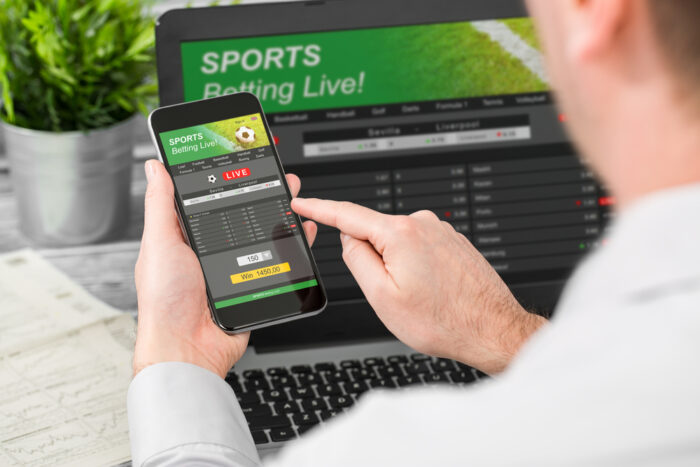
Pre-game sports betting often feels like an academic exercise. Handicappers spend days dissecting injury reports, running regression models, and scrutinizing market movement, only for an untimely turnover or a cold shooting slump to dismantle the entire thesis within minutes. Once the opening whistle blows, however, an entirely different financial market opens up.
Live in-play betting has exploded from a secondary sportsbook feature into the dominant driver of global sports wagering. It is heavily marketed to casual fans as an adrenaline-charged way to engage with every down, pitch, or possession. Yet the vast majority of recreational bettors treat the live screen like a digital slot machine, placing reactive wagers driven by raw emotion and whatever sequence of events just unfolded on their televisions.
For disciplined bettors, the live market represents something completely different: an asymmetric hunting ground. Automated algorithms generate in-game odds by translating basic box-score metrics into immediate probabilities, but mathematical algorithms routinely fail to understand context, human psychology, and strategic momentum. Finding value while the action is live requires understanding where these models are blind and having the composure to exploit their mistakes before the lines self-correct.
How Sportsbook Algorithms Price Live Action
To beat in-play odds, you have to understand how those numbers end up on your screen in the first place. No sportsbook employs armies of individual traders sitting in front of monitors manually recalculating spreads for thousands of concurrent sporting events. The pricing is almost entirely automated.
Third-party data providers feed real-time game states into proprietary software. The algorithms evaluate basic quantitative inputs: time remaining, score differential, ball possession, field position, and the original pre-game closing price. The software then recalibrates the win expectancy and generates updated lines within fractions of a second.
The fatal flaw of this automation is simple: algorithms process what happened, but they cannot evaluate how it happened.
An automated pricing engine views a seven-point lead in football identically, regardless of whether that lead was built through sustained, physical domination in the trenches or gifted via a bizarre muffed punt recovery. The machine cannot discern whether a star player is hobbling between whistles, whether a coach has made an aggressive schematic adjustment at halftime, or whether sudden weather shifts have effectively neutered downfield passing.
Furthermore, sportsbooks compensate for the volatility of live action by widening their theoretical hold, commonly known as the vig. While a standard pre-game spread typically features -110 juice on both sides (roughly a 4.5% bookmaker edge), live betting markets often widen to -115, -120, or even -125. That higher barrier to entry means you cannot simply bet whenever you have a mild hunch. You must target clear, structural mispricings where your perceived edge comfortably exceeds the increased house margin.
Capitalizing on Early-Game Overreactions
One of the most dependable sources of live betting value stems from public psychology and the resulting mathematical overreactions within pricing models. Humans suffer from severe recency bias, and casual sports bettors are among the most vulnerable to it.
When an established favorite falls behind early in a contest—say, a heavy basketball favorite misses their first eight field-goal attempts, or a dominant baseball ace surrenders two home runs in the opening frame—the betting public panics. Automated algorithms rapidly adjust downward to reflect the lost game time and current score deficit, while casual money piles onto the underdog.
This dynamic frequently produces extraordinary value on elite teams at steep discounts. If forty hours of pre-game quantitative analysis demonstrated that a football team possessed massive structural mismatches against their opponent, a random seven-point deficit five minutes into the first quarter does not magically erase that research. In fact, it often shifts a pre-game line of -8.5 down to a live line of -2.5 or a pick’em.
The key to profiting from early deficits lies in diagnostic observation. You must determine whether the underdog’s lead is the product of sustainable tactical superiority or low-probability variance:
-
High-Variance Triggers: Fumbles, tipped-pass interceptions, fluky defensive deflections, or unsustainable shooting percentages from outside shooters. When an underdog builds a lead off these events, the favorite remains an exceptional live wager because variance inevitably regresses toward historical averages.
-
Structural Triggers: Persistent offensive line penetration, decisive schematic advantages, or visible athletic mismatches in space. If an underdog leads because they are dominating physical matchups, do not step in front of the train simply because the favorite had a better pre-game reputation.
The Strategic Edge: Reading Context Over Box Scores
Box scores tell you the current reality, but context tells you what happens next. In-play betting rewards the bettor who can process intangible variables faster than a software script can log them.
Pace and Shooting Regression in Basketball
Live basketball totals are notoriously erratic, making them prime targets for observant bettors. When two NBA or college basketball teams combine for seventy points in the opening twelve minutes, automated models automatically ratchet the full-game total upward by fifteen to twenty points.
More often than not, early offensive explosions are fueled by unsustainable exterior shooting rather than extraordinary possession volume. Teams rarely sustain a 65% three-point conversion rate over forty-eight minutes. As player legs fatigue and defensive communication tightens, shooting percentages inevitably decline.
If you track possession counts and observe that the actual pace of the game is moderate, but the live total has inflated strictly due to exceptional shooting luck, taking an in-play under on an inflated line is one of the highest-expected-value moves in basketball wagering.
Tactical Shifts and In-Game Attrition
Automated models adjust when a star player leaves the court with an injury, but they struggle to price the subtle secondary effects of tactical changes and foul trouble.
Consider an elite defensive center in the NBA who collects two personal fouls in the first four minutes of a contest. The head coach pulls him to the bench for the remainder of the first half. A standard live model might ding the defensive team by a point or two, but it rarely accounts for how fundamentally the paint collapses without that rim protection. The opposing offense now has unimpeded driving lanes for twenty consecutive minutes, dramatically boosting both their scoring efficiency and their pace of play.
In soccer, tactical realignments create similar market disconnects. A manager trailing 1-0 at the sixty-minute mark who substitutes a defensive midfielder for an additional attacking striker fundamentally changes the pitch geometry. The match will either feature an equalizer or a catastrophic defensive breakdown on the counterattack. An observant bettor can exploit this reality by targeting live alternate goal lines before the increased shot volume materializes on the stat sheet.
Environmental Elements in Outdoor Stadiums
While pre-game betting markets heavily incorporate forecasted weather, live conditions frequently diverge from predictions. A steady breeze can turn into twenty-five-mile-per-hour crosswinds mid-game, severely compromising field-goal ranges and deep passing accuracy in football.
If you observe stadium flags snapping violently or punters visibly struggling to control ball flight, the live market may take two or three possessions to fully digest the drop in scoring efficiency. Stepping in on live unders or fading long field-goal props before the market adjusts offers a distinct informational advantage.
Navigating In-Game Key Numbers
In football handicapping, the numbers 3, 7, 10, and 14 govern point spread evaluation because of the scoring mechanics of field goals and touchdowns. In pre-game markets, bettors fight over half-points around these critical thresholds. In live betting, understanding key numbers becomes an even sharper weapon.
When a live game fluctuates, point spreads whip across key numbers with breathtaking speed. For instance, if a pre-game -7 favorite surrenders an opening score, their live spread will frequently drop to -1.5, pick’em, or even +1.5.
Savvy live bettors wait for scores to cross specific scoring barriers. Backing a superior team as a live underdog at +3.5 offers tremendous structural security compared to laying points before kickoff. If the favored team mounts a fourth-quarter comeback and wins by a routine field goal, you cash your ticket on both the victory and the original game thesis. Never place a live football wager without considering whether the current line sits on a dead number like 2, 5, or 8, or whether waiting half a possession might land your bet on a far more valuable 3 or 7.
Live numbers also open up lucrative middle opportunities. If you placed a pre-game wager on an underdog at +7.5, and they jump out to a 14-0 lead, the live spread on the favorite might swing to +3.5 or +4. By selectively backing the favorite at the live plus-number, you create a wide middle window where both wagers can cash if the game finishes within the margin, all while risking minimal capital.
Technical Traps and Execution Discipline
Having an analytical edge means nothing if your execution is fundamentally flawed. In-play betting presents several structural hazards that trip up even intelligent handicappers.
The Broadcast Latency Trap
The single most dangerous misconception among casual live bettors is the belief that they are seeing the game in real time. Unless you are physically sitting inside the stadium, your video feed is delayed.
Standard cable television broadcasts run on a delay of five to ten seconds. Satellite feeds often lag by fifteen seconds, and digital streaming platforms can run anywhere from twenty to sixty seconds behind the actual live action.
Meanwhile, sportsbooks utilize courtside scouting networks, ultra-low-latency radar feeds, and direct official league data partnerships that update the betting engine within milliseconds. If you see a quarterback launch a deep pass on your television and frantically attempt to bet the over, the sportsbook’s software has already registered the completed pass and suspended the market before you can unlock your screen.
Never attempt to bet on reactive moments. Treat the live board not as a race against the sportsbook’s feed, but as an opportunity to bet during extended commercial timeouts, between innings, or at halftime, when play has paused, lines have settled, and your analytical read matters far more than transmission speed.
Bankroll Erosion and Emotional Tilt
The sheer speed of live betting can accelerate poor habits. When a bettor drops an afternoon pre-game wager, the natural human urge is to chase that loss immediately. The live betting menu provides a continuous stream of opportunities to do exactly that, encouraging undisciplined players to fire multiple bets on random third-quarter possessions.
To survive the live ecosystem, you must enforce rigid operational parameters:
-
Pre-Set Unit Sizing: Never increase your bet size in-game to compensate for previous losses. Live bets should never exceed your standard pre-game unit allocation; in fact, given the higher vig, fractional units are often more appropriate.
-
Limit Your Event Focus: Attempting to track three different live games simultaneously destroys your ability to spot nuanced tactical edges. Focus on one single game where you already possess deep familiarity with both rosters and schemes.
-
The Standby Rule: If the market does not offer an undeniable mathematical or situational edge, do nothing. Refusing to place a wager during a live game is just as profitable as making a winning one, as it preserves your capital for the moments when sportsbooks make genuine pricing blunders.
Live in-play betting transforms watching a game from a passive entertainment experience into a dynamic test of tactical acumen. Success does not come from reacting to every big play with an impulsive tap on your phone. It comes from patience, preparation, and the ability to spot the exact moments when algorithmic calculations lose touch with physical reality on the field. When you treat the live board with the rigorous standard of a financial trader rather than an excited spectator, in-game volatility turns into a consistent operational edge.